What Is It? Symptoms Am I a Candidate? How Surgery Works Request Consultation
Division of Spine and Spine Tumor Neurosurgery
Interactive Patient Education

Lumbar Disc Disease
Sciatica & Disc Treatment

The discs that cushion your lower back can wear down or herniate, pressing on a nerve root and sending pain, numbness, or weakness down the leg — commonly called sciatica. This page explains what is happening, helps you explore which nerve your symptoms fit, and walks through the options, from non-surgical care to microdiscectomy, endoscopic discectomy, and fusion when the spine is unstable.
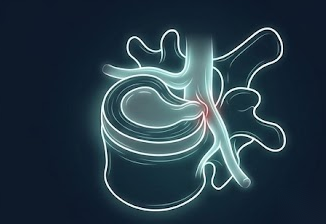
Neon illustration of a lumbar vertebra with a herniated disc pressing a nerve root

A herniated disc can pinch a nerve to the leg

What Is Lumbar Disc Disease?

A catch-all term for the age-related wear, bulging, and herniation of the cushioning discs in the lower back, which can crowd the nerves that travel to the legs.

Between each pair of lower-back bones sits a disc: a tough outer ring around a soft, gel-like center. With age these discs lose water and height and the outer ring weakens. Sometimes the soft center pushes through the ring — a herniation — into the spinal canal, where it can press on a nerve root. When that happens, the classic result is sciatica: pain, numbness, tingling, or weakness that travels from the low back or buttock down a specific path into the leg and foot.

Which nerve is affected depends not only on the level but on the direction of the herniation. A herniation just off the midline (paracentral) usually catches the nerve traveling past that level (the traversing root), while a herniation out to the side (far-lateral) tends to catch the nerve exiting at that level. You can explore this in the interactive tool below.

The good news is that most lumbar disc herniations improve on their own over weeks to months. When surgery is needed, our approach at Brown is least-invasive-first: relieve the nerve with the smallest effective operation, and reserve fusion for situations where the spine is genuinely unstable. The reasoning behind each option is explained throughout this page.

At a Glance
Most common levels: L4–L5 and L5–S1
Hallmark symptom: sciatica (leg pain)
Direction matters: paracentral vs far-lateral
First-line care: time, therapy, medication, injections
Most common surgery: microdiscectomy
Surgery aim: free the nerve; fuse only if unstable

Herniation

The soft disc center pushes through the outer ring into the canal and can press on a nerve root to the leg.

Sciatica

A pinched nerve sends pain, numbness, or weakness down a specific path into the buttock, leg, and foot.

Direction Matters

A paracentral herniation hits the traversing root; a far-lateral one hits the exiting root at that level.

Often Self-Limited

Most herniations shrink and settle over weeks to months, so patience and non-surgical care come first.

🚩

Warning signs that need urgent evaluation

Most sciatica is not an emergency, but seek care right away for: new loss of bladder or bowel control, numbness in the groin or inner thighs (the "saddle" area), or rapidly worsening weakness in one or both legs. These can signal cauda equina syndrome — severe compression of the nerve bundle — which is a surgical emergency.

Which Symptoms Does Treatment Help?

Relieving pressure on a nerve is very good at easing leg symptoms and less reliable for back pain alone. Select a symptom to see what to realistically expect.

Select a symptom to see how treatment typically affects it.

Which Nerve Is Affected?

Different lumbar levels and herniation directions map to different nerves, which is why one person feels the top of the foot and another the sole. Pick a level and herniation direction to see which nerve root that pattern most often fits — educational, not a diagnosis.

Lumbar / Sacral Nerve Root Localizer
Level & herniation direction → nerve root, dermatome, myotome, and reflex
Open full screen ↗

This interactive tool is provided by the Norman Prince Spine Institute. It is a pattern-recognition aid for education and should be correlated with your exam and imaging by a clinician.

Am I a Candidate?

Several factors shape whether surgery makes sense and which operation fits. Choose a category, then select a factor to learn more.

Select a factor to see how it affects candidacy and which operation fits.

From Non-Surgical Care to Surgery

Most people improve without surgery. An operation is considered when leg symptoms are severe or persistent despite a fair trial, when there is significant weakness, or urgently if there are signs of cauda equina syndrome.

First · Non-Surgical Care

Time, Therapy, and Injections

The majority of lumbar disc herniations improve within six to twelve weeks. Physical therapy, activity changes, anti-inflammatory or nerve-pain medication, and, in selected cases, an epidural steroid injection can control symptoms while the herniation shrinks and the nerve settles. Surgery is rarely urgent unless there is major weakness or cauda equina syndrome.

When Needed · Surgery

Free the Nerve

When surgery is warranted, the goal is simply to remove the fragment of disc pressing on the nerve — not the whole disc, and usually without fusing anything. This can be done through a small open incision (microdiscectomy) or an even smaller endoscopic portal. Fusion is added only when the segment is also unstable.

The Main Operations

Select an operation to see, in one place, how it works step by step and what to expect. At Brown we favor the least-invasive effective approach and reserve fusion for genuine instability.

See inside an endoscopic discectomy

Endoscopic surgery is a signature strength of our division. Explore our interactive tool to see just how small the portal is compared with other approaches, and what the surgeon sees through the scope as the fragment is removed.

Curious how a fusion is stabilized?

When a disc problem also needs fusion, the level is held with screws and rods. See how those screws are placed through incisions about a centimeter long, using robotic navigation.

The Operations at a Glance

All three operations, side by side. For a straightforward herniation the first two both remove the offending fragment and free the nerve — the difference is mostly the size of the corridor; fusion is added only for genuine instability. The best choice depends on your anatomy and the herniation, decided with your surgeon.

OperationCorridorFusionBest forTypical recovery
MicrodiscectomySmall open incision · microscope Small incision (~2–3 cm), microscope No — motion preserved Most herniations, including larger or migrated fragments Usually same day; light activity in days to ~2 weeks
EndoscopicPencil-width portal · camera Pencil-width portal, high-definition scope No — motion preserved Focal herniations in favorable positions Usually same day; return to light activity in days
Discectomy + FusionDecompress and stabilize Fragment removed, then a cage and screws Yes — the level is joined Herniation with instability or slippage 1–2 nights; longer while the fusion heals

None is universally better. The aim is to remove exactly what is pinching the nerve through the smallest corridor that does the job safely, and to add fusion only when the level is genuinely unstable.

Common Questions

Do I need surgery, or can I wait?
Most lumbar disc herniations improve within a few weeks to a few months, so waiting is reasonable for many people. Surgery becomes sensible when leg pain is severe or persistent despite a fair trial of non-surgical care, or when there is meaningful weakness. The main exception is cauda equina syndrome — new bladder or bowel changes, saddle numbness, or rapidly progressive leg weakness — which is a surgical emergency.
Will surgery fix my back pain too?
Discectomy is aimed at the leg pain caused by a pinched nerve, and it is very good at that. Back pain is less predictable, because much of it comes from the worn disc and joints rather than the pinched nerve. If your pain is mostly in the leg, you are more likely to be pleased; if it is mostly in the back, the conversation is different.
Will the disc herniate again?
A microdiscectomy removes the fragment pressing on the nerve, not the entire disc, so the same disc can herniate again in roughly 5 to 10 percent of patients. Maintaining core strength, using good body mechanics, and not smoking all help protect the result. If a disc does reherniate, a repeat discectomy or, occasionally, a fusion can be considered.
What is the difference between microdiscectomy and endoscopic discectomy?
Both remove the disc fragment and free the nerve; the difference is the size of the corridor. A microdiscectomy uses a small open incision and a microscope; an endoscopic discectomy works through a portal about the width of a pencil using a camera. Both are effective; the choice depends on the size and position of the herniation and your anatomy.
Why do I feel it in my foot and not my back?
A nerve root pinched in the low back carries sensation and strength for a specific strip of the leg and foot, so the symptoms are felt where that nerve travels rather than at the spot of the problem. Which part of the leg or foot is involved is a clue to which nerve is affected, which you can explore in the interactive tool above.
When is a fusion needed for a disc problem?
Most disc herniations need only the fragment removed, with no fusion. Fusion is added when the segment is also unstable — for example a slipping vertebra (spondylolisthesis), significant deformity, or recurrent herniation with instability — where simply removing disc material could let the segment move abnormally. It is a deliberate addition, not a default.
Is the numbness and weakness reversible?
Leg pain often eases quickly once the nerve is freed. Numbness and weakness can also recover, but more gradually, and long-standing or severe compression may leave some lasting numbness. This is one reason not to wait until symptoms are severe, and why progressive weakness should be evaluated sooner rather than later.

Who We Are

This educational resource was developed by the Division of Spine and Spine Tumor Neurosurgery at Brown University Health to help patients and families understand lumbar disc disease and its treatment options. Our surgeons offer the full spectrum of care, from endoscopic and minimally invasive discectomy to fusion when needed, and work closely with physical therapy, pain management, and physiatry so that surgery is recommended only when it is the right next step.

For full faculty profiles, visit the Brown Neurosurgery Spinal Surgery Division.

What Is It?SymptomsWhich Nerve?CandidacyTreatmentHow Surgery WorksCompareFAQ