What Is It? Symptoms Am I a Candidate? How Surgery Works Request Consultation
Division of Spine and Spine Tumor Neurosurgery
Interactive Patient Education

Scoliosis & Spinal Deformity
Curves, Bracing & Stabilization

Scoliosis is a sideways curve of the spine. Some curves are small and simply watched, some are held in check with a brace while a child grows, and some are straightened and stabilized with surgery. Explore how curves are measured in degrees, what secondary problems they can cause, and how we decide when a curve is stable enough to watch and when it needs treatment.

A curve can progress over time — or be braced and stabilized

What Is Scoliosis?

A sideways curve of the spine, usually with some rotation. How large the curve is (measured in degrees), why it formed, and whether it is getting worse all shape what happens next.

Seen from behind, a healthy spine runs straight down the middle. In scoliosis, it curves sideways into a C or S shape and the vertebrae also twist, which is what produces the uneven shoulders, a shoulder blade that sticks out, an uneven waist, or a rib prominence that shows when a person bends forward. A curve has to measure at least 10 degrees on X-ray, by the Cobb angle, to be called scoliosis; smaller curves are normal variation.

Scoliosis is not one disease. In children and teenagers it is most often idiopathic, meaning it appears during growth with no clear cause. In older adults a curve can develop for the first time from wear and tear of the discs and joints; this is degenerative (or de novo) scoliosis, and it often comes with the leg symptoms of a narrowed spinal canal. Curves can also come from vertebrae that formed abnormally before birth (congenital) or from conditions affecting the muscles and nerves (neuromuscular).

Two questions drive almost every decision: how big is the curve, and is it stable or getting worse? A small, stable curve is simply watched. A curve that is still growing in a child may be braced to stop it from progressing. A large curve, or one causing nerve compression, imbalance, or relentless progression, is where surgery to straighten and stabilize the spine is discussed. At Brown, our approach is to match the treatment to the curve: watch what can be watched, brace what bracing can help, and reserve surgery for curves that genuinely need it.

At a Glance
Definition: sideways curve of 10° or more (Cobb angle)
Most common type: idiopathic, appearing during growth
In adults: often degenerative, with leg symptoms
Measured by: degrees of curvature on X-ray
Key question: stable, or progressing?
Treatments: observation, bracing, or surgery

Warning signs that need urgent evaluation

Scoliosis itself is rarely an emergency, but seek care right away for new loss of bladder or bowel control, numbness in the groin or inner thighs (the "saddle" area), or rapidly worsening leg weakness or numbness. In young children, a rapidly progressing curve or new breathing difficulty also warrants prompt evaluation. These can signal nerve compression or, rarely, an underlying spinal cord problem.

The Main Types of Scoliosis

The cause matters, because it changes who gets the curve, how likely it is to progress, and what treatment makes sense. These four types cover the great majority of patients across the lifespan.

Most common

Idiopathic

Appears during growth with no identifiable cause, most often as adolescent idiopathic scoliosis (AIS) in the pre-teen and teen years. Girls are more likely to have curves that progress. This is the classic "curve found at a school or pediatric screening."

Present from birth

Congenital

Caused by vertebrae that did not form normally before birth. Because the shape of the bone is the problem, these curves can progress even in very young children and are followed closely from an early age.

Underlying condition

Neuromuscular

Develops when conditions such as cerebral palsy, muscular dystrophy, or spina bifida affect the muscles and nerves that support the spine. These curves tend to be longer, progress steadily, and are managed as part of the whole condition.

Scoliosis is a sideways (coronal) curve. A separate but related deformity is kyphosis, an excessive forward rounding seen from the side; some patients have both, and the balance of the spine front-to-back matters as much as the sideways curve when planning treatment.

Degrees of Curvature: The Cobb Angle

Scoliosis is measured in degrees using the Cobb angle. Drag the slider to increase the curve and see how the measurement changes, which management "zone" it falls into, and what secondary problems tend to appear as a curve grows. This is educational only, not a measurement of your own spine.

These thresholds are general guides for a growing child; the real decision also depends on age, remaining growth, curve type and location, symptoms, and how the curve behaves over time. This is a simplified illustration, not a measurement or diagnosis of your own spine.

What Problems Can Scoliosis Cause?

Small curves often cause nothing at all. As curves grow, or in adults with degenerative curves, a range of secondary problems can appear, some of which signal a need for more active treatment. Select one to see what it means and how treatment typically helps.

Select a symptom to see what it means and how treatment typically affects it.

Stable or Unstable? Am I a Candidate?

The single most important question is whether a curve is stable or progressing, because that separates a curve to watch from one to treat. Curve size, growth remaining, symptoms, and overall health all factor in. Choose a category, then select a factor.

Select a factor to see how it affects whether a curve is watched, braced, or treated surgically.

From Watching to Bracing to Surgery

Treatment climbs a ladder from least to most involved. The goal is always the same: keep the spine balanced and the nerves free, using the least that will do the job.

First · Non-Surgical Care

Observation and Bracing

Small and stable curves are simply monitored with periodic X-rays. In a child who is still growing, a well-fitted brace worn for the recommended hours a day can stop a moderate curve from getting worse and often avoids surgery altogether. Bracing does not straighten a curve; it holds the line while growth finishes. Physical therapy, exercise, and, in adults, pain management support comfort and function.

When Needed · Surgery

Straighten and Stabilize

Surgery is considered for large curves, curves that keep progressing despite bracing, and curves causing nerve compression or a spine that leans out of balance. The surgeon corrects the curve and holds the spine in its new position with screws and rods, then fuses the segment so the correction is permanent. In adult degenerative curves, the nerves are also decompressed.

The Main Paths

Select an option to see how it works and when it is chosen. At Brown we favor the least-invasive effective step and reserve fusion for curves that truly need straightening and stabilizing.

How is the corrected spine held in place?

When a curve is corrected, screws and rods hold the spine in its new alignment while it fuses. See how those screws are placed accurately through the pedicles using robotic navigation.

How Deformity Correction and Fusion Works, Step by Step

This walks through a typical posterior instrumented fusion, the most common operation for a large or progressive curve. Select each step to learn what happens and why.

Select a step to learn what happens, and why.
Explore the whole operation in depth

Step inside a posterior instrumented fusion: an interactive, step-by-step walkthrough of the operation and of how much spine is fused and what that trades off — tailored to adolescent or adult curves.

What Outcomes Can Patients Expect?

Modern deformity surgery reliably straightens and stabilizes the spine, and in adults it relieves the leg symptoms of nerve compression well. Results vary with the type and size of curve, and honest expectations matter.

~50–70%
Typical Curve Correction
How much a flexible curve is straightened varies; the aim is a balanced spine, not a perfectly straight one.
~80–90%
Leg-Symptom Relief (Adults)
In degenerative curves, decompressing the pinched nerves relieves leg pain and claudication in most patients.

Risks and Honest Trade-offs

Deformity surgery is major surgery. General risks include bleeding (which can be significant in longer fusions), infection, and the risks of anesthesia. Because the work is close to the spinal cord and nerves, there is a small risk of new weakness or numbness; this is why continuous nerve monitoring is used throughout the operation to protect them.

Longer-term considerations include a small chance the bone does not fully knit (nonunion), which smoking raises; hardware that occasionally needs revision; and, in adults especially, added wear or a new bend at the level just above or below the fusion (adjacent-segment disease or proximal junctional kyphosis). Recovery takes months as the fusion matures. These trade-offs are exactly why a small, stable curve is watched rather than fused.

Bracing vs. Surgery

For a growing child with a moderate curve, this is often the central decision. They are different tools for different jobs, chosen with your team based on curve size, growth remaining, and how the curve is behaving.

FeatureBracingSurgery (Fusion)
What it doesHolds a curve from getting worse while a child growsStraightens the curve and makes the correction permanent
Straightens the curve?No; it prevents progressionYes; partially corrects and balances the spine
Adds hardware?No; an external braceYes; screws and rods, then fusion
Curve sizeRoughly 20–40° in a growing childUsually 45–50° or more, or relentless progression
Reversible?Yes; it is removableNo; a fused segment is permanent
ConsiderationBracingSurgery
Still growingIdeal; growth is what bracing works withTimed around growth and curve behavior
Skeletally matureLittle benefit once growth is doneChosen on curve size and symptoms
Curve under ~45°Often the right first toolUsually not yet needed
Curve 50°+ or progressing despite a braceHas little more to offerPreferred
Nerve compression / imbalance (adults)Symptomatic support onlyDecompress and stabilize
FactorBracingSurgery
Daily lifeWorn many hours a day; most activities and sports continueHospital stay of several days, then a staged return to activity
Hospital stayNoneTypically 3–6 nights for a larger deformity
Full recoveryOngoing while growing; no recovery periodSeveral months as the fusion matures
Long-term considerationCurve may still need surgery laterAdjacent-segment wear over years; durable correction

The aim is to match the tool to the curve: watch small stable curves, brace growing moderate ones, and reserve surgery for curves large enough or progressive enough to need straightening and stabilizing.

Optimize Bone Health for Better Fusion Outcomes

A fusion only succeeds if the bone heals around the hardware and keeps its grip on the screws. When bone is thin, screws loosen, cages settle into the vertebra, and the fusion can fail to knit — so when a fusion is part of the plan, strengthening the bone beforehand is part of the operation, not an afterthought.

Spinal hardware is only as strong as the bone it anchors into. In osteoporotic bone, pedicle screws pull out or loosen more often, interbody cages can sink into the soft vertebral body (subsidence), and the fusion is slower and less certain to form a solid bridge — a higher risk of pseudarthrosis, or non-union. Longer, multi-level constructs carry the most bone-related risk, including new fractures at the top of the construct. Weak bone rarely rules surgery out, but it changes how we plan and prepare for it.

Before an elective fusion we take stock of the bone. A DEXA scan gives a T-score, and a CT you may already have gives a direct read of bone density — in Hounsfield units — at the very levels we plan to instrument, which is often more reliable than DEXA when the spine is arthritic. Bloodwork checks vitamin D and screens for reversible causes of bone loss.

When the numbers are low and the operation is elective, we treat the bone first. The strongest evidence is for anabolic (bone-building) agents — teriparatide, abaloparatide, or romosozumab. When the timeline allows, starting an anabolic roughly 2–3 months before surgery and continuing it 6–12 months afterward is associated with higher fusion rates and fewer loose screws, and it is then followed by an antiresorptive to hold the gains. Building first and protecting second is the sequence that adds the most strength. Urgent or unstable cases are not delayed — there we optimize around the operation instead of before it.

Getting Bone Fusion-Ready
Build (anabolic)
Teriparatide and abaloparatide (daily injections) and romosozumab (monthly) grow new bone. Best started before an elective fusion when the schedule permits.
Protect (antiresorptive)
Bisphosphonates and denosumab hold the gains after the building course. Denosumab must never be stopped without a planned hand-off, or bone loss rebounds.
Sequence
Anabolic first, antiresorptive second. Starting with a bisphosphonate blunts a later anabolic’s effect.

Coordinated with your surgeon and a bone-health physician, and weighed against how urgent surgery is. General education, not a prescription.

The Numbers Your Surgeon Watches

Clinical reference

The thresholds below are what teams use to decide when bone is weak enough to treat, and weak enough to optimize before an elective fusion. Shared here for transparency; your own targets are set by your physicians.

DEXA T-score
  • Normal≥ −1.0
  • Osteopenia−1.0 to −2.5
  • Osteoporosis≤ −2.5

A prior fragility fracture counts as osteoporosis on its own. DEXA can read falsely high over spinal arthritis, so a normal DEXA does not fully clear weak bone before a fusion.

CT Hounsfield units (L1)
  • Reassuring> 160 HU
  • Intermediate110–160 HU
  • Osteoporosis range< 110 HU

Read from a CT you may already have. Loose hardware, cage subsidence, and non-union climb as this falls; many surgeons flag roughly < 120 HU at the instrumented levels as worth optimizing before elective surgery.

When we optimize first

Any one of these shifts an elective fusion toward treating the bone beforehand:

  • A prior fragility or vertebral fracture
  • T-score ≤ −2.5, or L1 CT < ~120 HU
  • High 10-year fracture risk (FRAX)
  • A long or multi-level instrumented construct

Common Questions

Will a brace straighten my child's spine?
No, and that is an important expectation to set. A brace is designed to keep a curve from getting worse while a child finishes growing, not to reverse it. When it works, the curve stays where it is and surgery is avoided. The trade-off is that a brace only helps while there is growth left, and it has to be worn for the recommended number of hours a day to do its job.
At what curve size is surgery needed?
There is no single magic number, but as a general guide, curves that reach roughly 45 to 50 degrees, or that keep progressing despite bracing, are where surgery is usually discussed. Curves that pass about 50 degrees tend to keep worsening slowly even into adulthood, which is why that range is often the threshold. The real decision also weighs age, remaining growth, curve location, balance, and symptoms, not the number alone.
Does scoliosis cause pain?
In children and teens, idiopathic scoliosis is often painless and is found by its appearance rather than by symptoms; significant pain in a young person deserves a closer look for another cause. In adults, pain is more common, both from the curve itself and, in degenerative scoliosis, from arthritis and pinched nerves. Where the pain comes from guides whether the answer is therapy, injections, or surgery.
Can scoliosis affect breathing or other organs?
Only large curves, generally well above the surgical threshold, and especially curves that begin very early in childhood, can crowd the chest enough to affect the lungs and breathing. Ordinary adolescent or adult curves rarely reach that point. This risk is one of the reasons very large or early-onset curves are treated more actively.
Can my child still play sports and be active in a brace?
Yes. Staying active is encouraged, and most sports and activities continue, with the brace usually removed for sports and worn the rest of the day. Exercise and physical therapy support the spine and general health. Activity does not wear the spine out; a strong, active body handles a curve better.
My curve started as an adult. Is that different from a child's scoliosis?
Yes. A curve that appears for the first time in adulthood is usually degenerative, driven by wear of the discs and joints rather than by growth. Bracing plays little role, because there is no growth to work with. The focus shifts to symptoms: therapy, injections, and pain management first, and surgery to decompress the nerves and stabilize the spine when there is nerve compression, imbalance, or progression that is limiting your life.
Will I be taller after surgery, and is the spine safe during the operation?
Straightening a curve can add a modest amount of height, though that is a side benefit rather than the goal. Because the surgery works right alongside the spinal cord and nerves, the team uses continuous nerve monitoring throughout, which provides a real-time safety check and makes serious nerve injury uncommon. The aim is a balanced, stable spine that lets you stand and move more comfortably.
How often should a curve be checked?
It depends on age and curve size. A growing child with a moderate curve may be seen every few months, because growth is when curves change fastest, while a small or stable curve is checked less often. Adults with degenerative curves are followed based on symptoms and any signs of progression. The point of monitoring is to catch a curve that is becoming unstable early, when there are still gentler options.
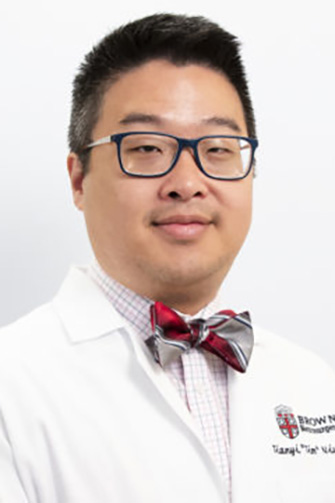

Who We Are

This educational resource was developed by the Division of Spine and Spine Tumor Neurosurgery at Brown University Health to help patients and families understand scoliosis and spinal deformity across the lifespan. Our surgeons care for curves from childhood through older adulthood, offering the full spectrum from observation and bracing to minimally invasive and complex deformity correction, and work closely with pediatrics, physical therapy, and pain management so that treatment is matched to the curve.

For full faculty profiles, visit the Brown Neurosurgery Spinal Surgery Division.

What Is It?TypesDegrees of CurvatureSymptomsCandidacyTreatmentHow Surgery WorksCompare Bone HealthFAQ