What Is It? Stable or Unstable? Brace or Surgery? What Happens? Request Consultation
Division of Spine and Spine Tumor Neurosurgery
Interactive Patient & Family Education

Spinal Trauma
Fractures, Cord Injury & Stabilization

A fall, a crash, or a hard hit can fracture the spine, and the key question is whether the injury is stable enough to heal in a brace or unstable enough to need surgery to protect the spinal cord. This page explains how surgeons tell stable from unstable, what a spinal cord injury means, and how bracing and surgical stabilization work, in plain language for patients and families.

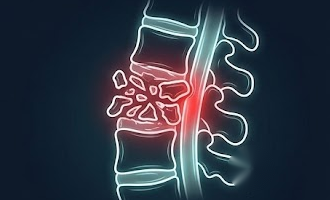
Neon illustration of a fractured, unstable spinal segment

A fractured vertebra can make the spine unstable

What Is Spinal Trauma?

An injury to the bones of the spine, the spinal cord, or both, usually from a sudden force. Two separate questions drive everything that follows: is the broken spine stable, and is the spinal cord hurt?

The spine is a stack of bones, the vertebrae, that both hold you upright and form a protective tunnel around the spinal cord, the bundle of nerves carrying signals between the brain and the body. A high-energy injury such as a car crash, a fall from height, or a diving accident can crack one or more of those bones. Lower-energy events can do it too when bone is already weak from osteoporosis.

Not all spinal fractures are equally serious. The single most important question a surgeon asks is whether the fracture is stable, meaning the spine can safely hold itself together while it heals, or unstable, meaning the broken pieces could shift and injure the spinal cord. Stable injuries often heal in a brace. Unstable injuries usually need surgery to rebuild the spine's support.

The second question is whether the spinal cord itself was injured. Many spinal fractures never touch the cord and cause no weakness or numbness at all. When the cord is injured, the effects and the recovery depend heavily on how complete the injury is, which we explain in plain terms further down this page.

At a Glance
Two questions: Is it stable? Is the cord hurt?
Common causes: crashes, falls, sports, weak bone
Stable fractures: often heal in a brace
Unstable fractures: usually need surgery
Goal of surgery: protect the cord, restore alignment
Cared for at: a Level I trauma center

Bone Injury

One or more vertebrae crack. The pattern of the break decides whether the spine is stable or not.

Cord Injury

Sometimes, but not always, the spinal cord is bruised or pressed. This is what causes weakness or numbness.

Bracing

A brace or collar holds a stable fracture still so the bone can heal on its own over weeks.

Stabilization

For unstable injuries, screws and rods rebuild the spine's support and take pressure off the cord.

🚨

After any spine injury, new symptoms are an emergency

Some people walk away from a crash or fall feeling fine, then develop numbness, weakness, or loss of bladder or bowel control hours or even days later as swelling or bleeding builds around the injury. Any new weakness, numbness, severe neck or back pain, or bladder or bowel changes after an injury needs immediate emergency evaluation. When in doubt, do not move the person and call for help.

Stable or Unstable? Explore Fracture Types

Surgeons judge stability by which parts of the spine are broken. Select a fracture type to see what it is, how stable it is, and how it is usually treated. This is educational, not a diagnosis of your own injury.

Anterior Middle Posterior cord

The three-column idea

Surgeons picture each vertebra as three stacked columns: a front (anterior), a middle, and a back (posterior). A fracture that breaks only one column is usually stable and often heals in a brace. When two or three columns fail, the spine can shift under load, so the injury is considered unstable and typically needs surgery. The middle column, right in front of the spinal cord, matters most.

1 column = usually stable2–3 columns = unstable
Select a fracture type below to see it on the spine.

Select a fracture type to see how stable it is and how it is treated.

What Symptoms Point To?

After a spine injury, symptoms range from pain alone to signs that the spinal cord or nerves are involved. Select a symptom to see what it usually means and how urgently it needs attention.

Select a symptom to see what it typically signals.

Understanding Spinal Cord Injury

Not every spinal fracture injures the spinal cord, but when it does, families understandably have urgent questions about recovery. Here is an honest, plain-language guide.

A note before you read on. This section discusses spinal cord injury, including the possibility of lasting weakness or paralysis. It is written to be honest and clear, because families tell us that straight answers help more than vague reassurance. Every injury is different, and the numbers here are averages, not predictions about any one person. Your care team is the right source for what applies to you.

A spinal cord injury happens when the cord is bruised, compressed, or torn, interrupting the signals that travel between the brain and the body below the level of the injury. The effects depend on two things: how high on the spine the injury is, and how complete it is. A higher injury affects more of the body. A more complete injury leaves less function preserved.

In the first hours and days, the team's job is to protect whatever function remains: keeping the spine still, maintaining good blood pressure and oxygen so the injured cord is not starved, and relieving pressure on the cord promptly when surgery can help. There is good evidence that decompressing a compressed cord early, often within the first day, gives the best chance of recovery. This is why an injured person is moved carefully and evaluated so quickly.

One of the hardest parts early on is uncertainty. In the first days, a state called spinal shock can make an injury look more complete than it truly is, so the earliest exam is not the final word. The clearest picture of long-term function usually emerges over the following weeks to months, and most neurological recovery that will happen tends to occur within the first six months to a year.

How Complete Is the Injury? The ASIA Scale

Doctors grade completeness with the ASIA Impairment Scale, a letter from A to E. Select a grade to see what it means and the general recovery outlook. Higher letters mean more preserved function.

Common Patterns of Incomplete Injury

When some function is preserved, the injury is incomplete, and it often follows a recognizable pattern. Incomplete injuries generally carry a better outlook than complete ones.

Brace or Surgery? What Tips the Balance

The choice between a brace and an operation weighs the fracture pattern, the spinal cord, alignment, and your overall health. Choose a category, then select a factor to see which way it points and why.

Select a factor to see how it influences the brace-versus-surgery decision.

From Bracing to Surgical Stabilization

Stable fractures are often treated without surgery. Unstable fractures, or any injury threatening the spinal cord, are stabilized surgically. Alongside either path, pain, mobility, and rehabilitation are managed from day one.

Often First · Non-Surgical

Bracing and Recovery

A stable fracture with a normal neurological exam can usually heal in an external brace or collar that holds the spine still while the bone knits, typically over six to twelve weeks, with pain control and guided activity.

When Needed · Surgery

Surgical Stabilization

An unstable fracture, a dislocation, or bone or blood pressing on the spinal cord is treated with surgery to realign the spine, relieve pressure on the cord, and hold everything in place with screws and rods while it fuses.

The Main Options

Select an option to see how it works and when it is chosen. At Brown we favor the least-invasive treatment that safely protects the spinal cord, and reserve larger operations for genuine instability or cord compression.

How is an unstable spine stabilized?

When a fracture is unstable, screws and rods hold the spine still while it heals. See how those screws are placed through small incisions, using robotic navigation.

How Surgical Stabilization Works, Step by Step

This walks through a typical stabilization operation for an unstable fracture. Select an option above to switch pathways, and select each step to learn what happens and why.

Select a step to learn what happens, and why.

What Outcomes Can Patients Expect?

Outcomes depend enormously on the injury. Bone almost always heals; nerve recovery is far less certain. Honest expectations matter most here.

>2 in 3
Stable Fractures, No Surgery
In neurologically intact patients with intermediate-severity thoracolumbar fractures, most can be managed without surgery and heal well.
~2%
Surgical Infection Risk
Deep wound infection after instrumented spinal fusion is uncommon, on the order of a couple of percent, though risk rises in major trauma surgery.

Risks and Honest Trade-offs

Stabilization surgery is major surgery. Its risks include infection, bleeding, blood clots, problems with the hardware, the need for further surgery, and, rarely, worsening of neurological function despite every precaution. General anesthesia carries its own risks, which rise with age and other illness. Bracing avoids these surgical risks but has trade-offs of its own: skin problems, discomfort, and, for some fractures, a slightly higher chance the bone heals in a more angled position.

It is also important to be clear about what surgery can and cannot do. Stabilizing the spine reliably restores its mechanical support and protects the cord from further injury, and it lets people get up and moving sooner. It does not, by itself, repair an already-injured spinal cord. When paralysis or numbness is present from the injury, surgery aims to give the cord its best chance to recover and to prevent additional harm, but it cannot promise to reverse what the injury has already done.

Recovery and Rehabilitation

Whether treated in a brace or with surgery, recovery from spinal trauma is a journey measured in weeks to months, and rehabilitation is as important as the initial treatment.

If there is a spinal cord injury

Rehabilitation after a cord injury is a specialized, team effort that continues well beyond the hospital, involving physical and occupational therapists, rehabilitation physicians, nurses, psychologists, and social workers. Its goals reach past strength alone: managing the bladder and bowel, protecting the skin, preventing complications, adapting the home, and supporting the emotional health of both the patient and the family. Meaningful gains in independence are common even when full recovery is not, and the people who do best are supported by a team and by loved ones who understand the road ahead.

Bracing vs. Surgical Stabilization

Both aim to let the spine heal in good alignment while protecting the cord. The difference is whether the support comes from the outside or is built in. The right choice depends on the injury and is decided with your surgeon.

FeatureBracingSurgical Stabilization
How support is givenAn external brace or collar holds the spine still from outsideScrews and rods rebuild support from inside
AnesthesiaNoneGeneral anesthesia
Hospital stayShort or none, depending on injuryA few days, longer if cord injury
Relieves cord pressure?NoYes, when decompression is included
Main downsidesSkin irritation, discomfort, possible mal-alignmentSurgical risks: infection, bleeding, hardware issues
SituationBracingSurgery
Stable fracture, normal examWell suitedUsually not needed
Unstable fractureNot sufficient alonePreferred
Cord or nerve compressionDoes not relieve pressurePreferred; allows decompression
Fracture-dislocationNot appropriateRequired
Multiple injuries / cannot tolerate a braceImpracticalOften favored to allow early mobilizing
FactorBracingSurgery
Time in braceTypically 6–12 weeksShorter or none; the hardware provides support
Getting up and movingAs comfort allows, guidedOften within a day or two of surgery
Long-term motionNo fused segmentsFused levels lose some motion
Follow-up imagingTo confirm the fracture stays alignedTo confirm healing and hardware position

Neither is universally better. A stable fracture in a well person is ideal for bracing; an unstable fracture or one pressing on the cord calls for surgery. Many decisions in between are genuine judgment calls made together with your surgeon.

Optimize Bone Health for Better Fusion Outcomes

A fusion only succeeds if the bone heals around the hardware and keeps its grip on the screws. When bone is thin, screws loosen, cages settle into the vertebra, and the fusion can fail to knit — so when a fusion is part of the plan, strengthening the bone beforehand is part of the operation, not an afterthought.

Spinal hardware is only as strong as the bone it anchors into. In osteoporotic bone, pedicle screws pull out or loosen more often, interbody cages can sink into the soft vertebral body (subsidence), and the fusion is slower and less certain to form a solid bridge — a higher risk of pseudarthrosis, or non-union. Longer, multi-level constructs carry the most bone-related risk, including new fractures at the top of the construct. Weak bone rarely rules surgery out, but it changes how we plan and prepare for it.

Before an elective fusion we take stock of the bone. A DEXA scan gives a T-score, and a CT you may already have gives a direct read of bone density — in Hounsfield units — at the very levels we plan to instrument, which is often more reliable than DEXA when the spine is arthritic. Bloodwork checks vitamin D and screens for reversible causes of bone loss.

When the numbers are low and the operation is elective, we treat the bone first. The strongest evidence is for anabolic (bone-building) agents — teriparatide, abaloparatide, or romosozumab. When the timeline allows, starting an anabolic roughly 2–3 months before surgery and continuing it 6–12 months afterward is associated with higher fusion rates and fewer loose screws, and it is then followed by an antiresorptive to hold the gains. Building first and protecting second is the sequence that adds the most strength. Urgent or unstable cases are not delayed — there we optimize around the operation instead of before it.

Getting Bone Fusion-Ready
Build (anabolic)
Teriparatide and abaloparatide (daily injections) and romosozumab (monthly) grow new bone. Best started before an elective fusion when the schedule permits.
Protect (antiresorptive)
Bisphosphonates and denosumab hold the gains after the building course. Denosumab must never be stopped without a planned hand-off, or bone loss rebounds.
Sequence
Anabolic first, antiresorptive second. Starting with a bisphosphonate blunts a later anabolic’s effect.

Coordinated with your surgeon and a bone-health physician, and weighed against how urgent surgery is. General education, not a prescription.

The Numbers Your Surgeon Watches

Clinical reference

The thresholds below are what teams use to decide when bone is weak enough to treat, and weak enough to optimize before an elective fusion. Shared here for transparency; your own targets are set by your physicians.

DEXA T-score
  • Normal≥ −1.0
  • Osteopenia−1.0 to −2.5
  • Osteoporosis≤ −2.5

A prior fragility fracture counts as osteoporosis on its own. DEXA can read falsely high over spinal arthritis, so a normal DEXA does not fully clear weak bone before a fusion.

CT Hounsfield units (L1)
  • Reassuring> 160 HU
  • Intermediate110–160 HU
  • Osteoporosis range< 110 HU

Read from a CT you may already have. Loose hardware, cage subsidence, and non-union climb as this falls; many surgeons flag roughly < 120 HU at the instrumented levels as worth optimizing before elective surgery.

When we optimize first

Any one of these shifts an elective fusion toward treating the bone beforehand:

  • A prior fragility or vertebral fracture
  • T-score ≤ −2.5, or L1 CT < ~120 HU
  • High 10-year fracture risk (FRAX)
  • A long or multi-level instrumented construct

Common Questions

How do doctors decide if my fracture needs surgery?
The main question is whether the fracture is stable. Surgeons look at which parts of the vertebra are broken on CT and MRI, whether the spine is well aligned, and above all whether the spinal cord or nerves are being compressed or already injured. A stable fracture with a normal neurological exam often heals in a brace. An unstable fracture, a dislocation, or any pressure on the cord usually points to surgery. Your overall health and other injuries factor in too.
What is the difference between a stable and an unstable fracture?
A stable fracture is one where the spine can safely hold itself together and heal without the broken pieces shifting. An unstable fracture is one where the support structures are damaged enough that the spine could move abnormally and injure the cord. Surgeons often think of the vertebra as three columns: breaking one column is usually stable, while breaking two or three is usually unstable. The stability explorer above walks through common patterns.
Will I be paralyzed?
Many spinal fractures never injure the spinal cord, and those patients have no paralysis at all. When the cord is injured, the outlook depends on how complete the injury is and how high on the spine it sits. Incomplete injuries, where some feeling or movement is preserved, generally have a better outlook than complete ones. In the first days, a temporary state called spinal shock can make things look worse than they are, so the earliest exam is not the final answer. Your team can give you the most accurate picture as it becomes clear over the following weeks.
Why does surgery sometimes need to happen so quickly?
When bone or a disc is pressing on the spinal cord, relieving that pressure sooner, often within the first day, gives the cord its best chance to recover and helps prevent further injury. Not every spinal fracture is an emergency, but a compressed or injured cord is time-sensitive, which is why the trauma team evaluates and images an injured spine so urgently.
How long will I have to wear a brace?
For a stable fracture treated without surgery, a brace or collar is usually worn for about six to twelve weeks while the bone heals, with follow-up X-rays to confirm the alignment holds. After surgery, some people wear a brace for comfort and others do not need one at all, because the screws and rods already provide support. Your surgeon will tell you what applies to your specific injury.
If I have surgery, will my spine still move normally?
Stabilization usually involves fusing the injured levels, which permanently joins those vertebrae so they no longer move relative to each other. Fusing a few levels in the middle of the back is often barely noticeable in daily life, while fusion across the neck or many levels has more effect on motion. Surgeons try to fuse as few levels as the injury allows, precisely to preserve as much natural movement as possible.
My relative seemed fine after the accident, then got worse. How?
This can happen and is exactly why any spine injury is taken seriously. After the initial trauma, swelling or bleeding around the injured area can build over hours to days and begin to press on the spinal cord, or an unstable fracture can shift with movement. New weakness, numbness, worsening pain, or loss of bladder or bowel control after an injury is an emergency and needs immediate evaluation, even if the person walked away from the accident.
Does Brown treat spinal trauma differently?
Spinal trauma at Brown is managed at a Level I trauma center, where neurosurgery, trauma surgery, neurocritical care, and rehabilitation work together from the moment a patient arrives. That coordination matters: it means an unstable spine can be imaged, stabilized, and, when needed, decompressed quickly, and that rehabilitation planning starts early rather than after the fact. Our spine team offers the full range of treatment, from bracing to complex reconstruction, so the plan can be matched to the injury rather than to what a given center happens to offer.

Who We Are

This educational resource was developed by the Division of Spine and Spine Tumor Neurosurgery at Brown University Health to help patients and families understand spinal trauma and its treatment. Our surgeons care for the full spectrum of spinal injuries at a Level I trauma center, from bracing of stable fractures to complex stabilization and decompression, working alongside trauma surgery, neurocritical care, and rehabilitation.

The full trauma-spine team includes additional faculty. For complete profiles, visit the Brown Neurosurgery Spinal Surgery Division. Team list is a draft for faculty to confirm.

What Is It?StabilitySymptomsCord InjuryBrace or Surgery?TreatmentWhat HappensOutcomesRecoveryCompare Bone HealthFAQ