What Is It? Symptoms Am I a Candidate? How Surgery Works Request Consultation
Division of Spine and Spine Tumor Neurosurgery
Interactive Patient Education

Spondylolisthesis
When a Vertebra Slips

Spondylolisthesis is the forward slipping of one vertebra over the one below it. Depending on how far it slips and why, it can cause back pain, sciatica, or the leg-heaviness of a narrowed canal. Explore how the slip is graded, see how it pinches the nerves, and learn when it is watched, decompressed, or fused.

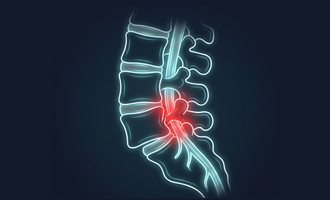
Neon animation of a vertebra slipping forward over the bone below

One vertebra slips forward over the bone below
What Is Spondylolisthesis?

A condition in which one vertebra slides forward over the vertebra beneath it. How much it slips is described by a grade, and why it slips defines the type.

The spine is a stack of bones (vertebrae) held in line by discs in front and paired facet joints behind. In spondylolisthesis, one vertebra loses part of that restraint and slides forward on the one below. The slip may be tiny and silent, or large enough to crowd the nerves and cause symptoms.

Two types cause most cases. In isthmic spondylolisthesis, a small stress fracture in a bony bridge called the pars (a pars defect) lets the vertebral body slide forward while the back part of the bone is left behind; this most often happens at L5–S1 and can begin in adolescence. In degenerative spondylolisthesis, the disc and facet joints simply wear out with age and let the whole vertebra drift forward, most often at L4–L5; because the back of the bone moves too, it tends to narrow the central canal and cause the leg-heaviness of spinal stenosis.

The amount of slip is graded with the Meyerding scale from I to IV (roughly, each grade is another 25% of forward slip). Grade, type, symptoms, and whether the segment is stable or moves abnormally all shape treatment. At Brown, our approach is least-invasive-first: relieve the nerves with the smallest effective operation, and add a fusion when the segment is genuinely unstable. The interactive tool below lets you see how the slip and its type change what the nerves feel.

At a Glance
Isthmic: pars defect, often L5–S1
Degenerative: wear-and-tear, often L4–L5
Grading: Meyerding I–IV (slip %)
Key question: stable or unstable?
First-line care: therapy, activity change, injections
Surgery aim: free the nerves; fuse if unstable

Pars Defect (Isthmic)

A stress fracture in a bony bridge lets the body slip forward while the back of the bone stays put, pinching the exiting nerve.

Wear-and-Tear (Degenerative)

Aging discs and facet joints let the whole vertebra drift, narrowing the central canal like spinal stenosis.

Meyerding Grade

The slip is graded I to IV by how far the vertebra has moved forward. Higher grades are less common.

Stability

Whether the segment moves abnormally on flexion/extension X-rays is the single biggest factor in deciding on fusion.

Warning signs that need urgent evaluation

Most spondylolisthesis is not an emergency, but seek care right away for new loss of bladder or bowel control, numbness in the groin or inner thighs (the "saddle" area), or rapidly worsening leg weakness. These can signal cauda equina syndrome, a surgical emergency.

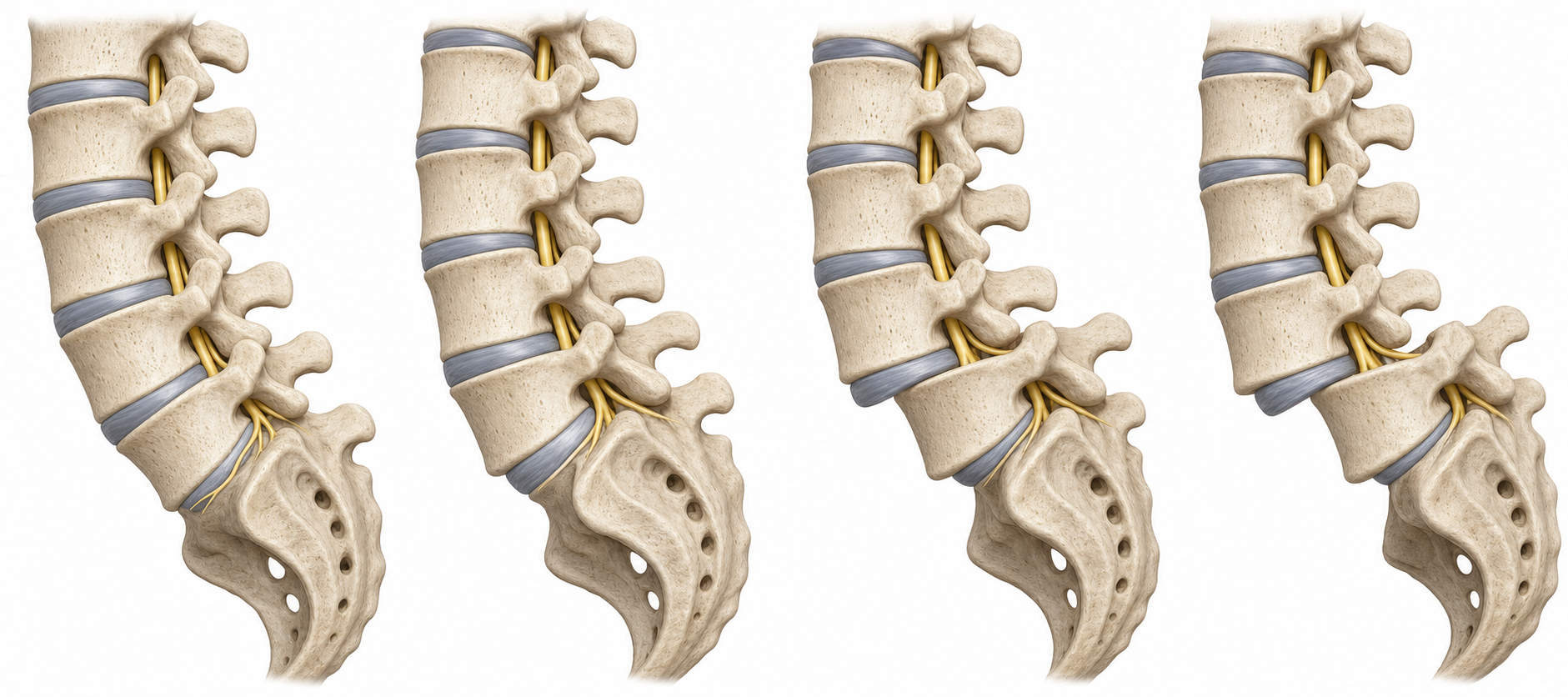
The Meyerding Grades

Spondylolisthesis is graded by how far the upper vertebra has slipped forward over the one below. Higher grades are less common and more likely to need surgery.

Meyerding Grades I through IV of spondylolisthesis: lateral lumbar spine illustrations showing progressive forward slip of the vertebra
Grade I
0–25%
Mild slip, usually managed conservatively
Grade II
26–50%
Moderate slip, surgery often needed
Grade III
51–75%
Severe slip, surgery indicated
Grade IV
76–100%
Near-complete displacement, complex surgery

Illustration for education. Grade is one input into treatment; symptoms and stability usually matter more than the number alone.

Slip Grade Simulator

Drag the slider to increase the forward slip, and switch the type, to see how the vertebra moves, how the grade changes, and where the nerves get pinched. This is educational only, not a measurement of your own spine.

Live SimulationGrade I · Low-Grade Slip
Meyerding Grade
Grade I
Forward Slip
10%
Central Canal
Open
Nerve Exit (Foramen)
Open
Amount of Slip
Drag to slide the vertebra forward10%
A degenerative slip moves the whole vertebra, so as it slides forward it narrows the central canal — the pattern behind the leg-heaviness of spinal stenosis.

This is a simplified illustration of how a slip crowds the nerves, not a measurement or diagnosis of your own spine.

Which Symptoms Does Treatment Help?

Surgery is very good at the leg symptoms of pinched nerves and, when a segment is unstable, at the pain of that instability. Select a symptom to see what to realistically expect.

Select a symptom to see how treatment typically affects it.

Am I a Candidate?

Grade, type, stability, symptoms, and health all shape whether surgery makes sense and whether a fusion is needed. Choose a category, then select a factor.

Select a factor to see how it affects candidacy and whether fusion is needed.

From Non-Surgical Care to Surgery

Many people do well without surgery. When surgery is needed, the two questions are the same as always: do the nerves need more room, and does the segment need to be held together?

First · Non-Surgical Care

Time, Therapy, and Injections

A low-grade, stable slip often responds to physical therapy focused on core and abdominal strength, activity changes, anti-inflammatory or nerve-pain medication, and, in selected cases, an epidural steroid injection. Many slips do not progress, so patience and rehabilitation come first.

When Needed · Surgery

Free the Nerves, Stabilize if Unstable

Surgery is considered when leg symptoms are severe or persistent, when there is significant weakness, or when the segment is unstable. The nerves are decompressed; a fusion is added when the slip is unstable, higher-grade, or when decompression alone would risk further slipping.

The Main Paths

Select an option to see how it works and when it is chosen. At Brown we favor the least-invasive effective approach and reserve fusion for genuine instability or deformity.

How is a slipping vertebra stabilized?

When a slip is fused, screws and rods hold the level in place while it heals. See how those screws are placed through small incisions, using robotic navigation.

How Decompression and Fusion Works, Step by Step

This walks through a typical decompression with fusion (for example a TLIF) for an unstable slip. Select each step to learn what happens and why.

Select a step to learn what happens, and why.

What Outcomes Can Patients Expect?

Surgery for symptomatic spondylolisthesis is one of the more reliable operations in spine surgery, especially for leg symptoms. Results vary, and honest expectations matter.

~80–90%
Leg Symptom Relief
Most patients get substantial relief of leg pain and claudication after the nerves are decompressed.
1–3 nights
Typical Stay (Fusion)
Decompression alone is often outpatient or one night; a fusion usually means a slightly longer stay and recovery.

Risks and Honest Trade-offs

Every spine operation carries risk. For decompression, the most common specific risk is a small tear in the lining around the nerves (a dural tear), usually repaired during surgery. Other risks include infection, bleeding, nerve irritation, and, less commonly, new or persistent weakness or numbness.

Fusion adds its own considerations: a longer recovery, a small chance the bones do not fully knit (nonunion), which smoking raises, and adjacent segment disease, where the levels next to a fusion carry more load over the years and may wear faster. This is precisely why a stable, low-grade slip is often better served by decompression alone (or no surgery) rather than a fusion it does not need.

Decompression Alone vs. Decompression + Fusion

For a slip, this is the central decision. A stable slip and an unstable one are different problems that favor different answers, decided with your surgeon.

FeatureDecompression AloneDecompression + Fusion
What it doesReopens the canal / foramen to free the nervesFrees the nerves and joins the segment with a cage and screws
Adds hardware?NoYes: interbody cage plus pedicle screws
Preserves motion?Yes, at that segmentNo; the slipped segment is made solid
Addresses instability?NoYes; stops the abnormal movement and can partly reduce the slip
Best forStable, low-grade slip with leg-dominant symptomsUnstable, higher-grade, or mechanically painful slips
ConsiderationDecompression Alone+ Fusion
Stable segmentOften sufficientUsually unnecessary
Unstable on flexion/extension X-raysRisk of further slipPreferred; stabilizes the segment
Mechanical back pain from the slipNot addressedDirectly addressed
Higher-grade slip / deformityRarely enough alonePreferred
Brown's default preferenceFavored when stableReserved for genuine instability
FactorDecompression Alone+ Fusion
Hospital stayOften same day to one nightTypically 1–3 nights
Return to light activity1–2 weeksSeveral weeks, with restrictions
Full recoveryA few weeks3–6 months as bone fuses
Long-term considerationPossible progression of the slipAdjacent-segment wear over years

The aim is to match the operation to the slip: reopen the nerves with the least disruption, and add stability only when the segment truly needs it.

Optimize Bone Health for Better Fusion Outcomes

A fusion only succeeds if the bone heals around the hardware and keeps its grip on the screws. When bone is thin, screws loosen, cages settle into the vertebra, and the fusion can fail to knit — so when a fusion is part of the plan, strengthening the bone beforehand is part of the operation, not an afterthought.

Spinal hardware is only as strong as the bone it anchors into. In osteoporotic bone, pedicle screws pull out or loosen more often, interbody cages can sink into the soft vertebral body (subsidence), and the fusion is slower and less certain to form a solid bridge — a higher risk of pseudarthrosis, or non-union. Longer, multi-level constructs carry the most bone-related risk, including new fractures at the top of the construct. Weak bone rarely rules surgery out, but it changes how we plan and prepare for it.

Before an elective fusion we take stock of the bone. A DEXA scan gives a T-score, and a CT you may already have gives a direct read of bone density — in Hounsfield units — at the very levels we plan to instrument, which is often more reliable than DEXA when the spine is arthritic. Bloodwork checks vitamin D and screens for reversible causes of bone loss.

When the numbers are low and the operation is elective, we treat the bone first. The strongest evidence is for anabolic (bone-building) agents — teriparatide, abaloparatide, or romosozumab. When the timeline allows, starting an anabolic roughly 2–3 months before surgery and continuing it 6–12 months afterward is associated with higher fusion rates and fewer loose screws, and it is then followed by an antiresorptive to hold the gains. Building first and protecting second is the sequence that adds the most strength. Urgent or unstable cases are not delayed — there we optimize around the operation instead of before it.

Getting Bone Fusion-Ready
Build (anabolic)
Teriparatide and abaloparatide (daily injections) and romosozumab (monthly) grow new bone. Best started before an elective fusion when the schedule permits.
Protect (antiresorptive)
Bisphosphonates and denosumab hold the gains after the building course. Denosumab must never be stopped without a planned hand-off, or bone loss rebounds.
Sequence
Anabolic first, antiresorptive second. Starting with a bisphosphonate blunts a later anabolic’s effect.

Coordinated with your surgeon and a bone-health physician, and weighed against how urgent surgery is. General education, not a prescription.

The Numbers Your Surgeon Watches

Clinical reference

The thresholds below are what teams use to decide when bone is weak enough to treat, and weak enough to optimize before an elective fusion. Shared here for transparency; your own targets are set by your physicians.

DEXA T-score
  • Normal≥ −1.0
  • Osteopenia−1.0 to −2.5
  • Osteoporosis≤ −2.5

A prior fragility fracture counts as osteoporosis on its own. DEXA can read falsely high over spinal arthritis, so a normal DEXA does not fully clear weak bone before a fusion.

CT Hounsfield units (L1)
  • Reassuring> 160 HU
  • Intermediate110–160 HU
  • Osteoporosis range< 110 HU

Read from a CT you may already have. Loose hardware, cage subsidence, and non-union climb as this falls; many surgeons flag roughly < 120 HU at the instrumented levels as worth optimizing before elective surgery.

When we optimize first

Any one of these shifts an elective fusion toward treating the bone beforehand:

  • A prior fragility or vertebral fracture
  • T-score ≤ −2.5, or L1 CT < ~120 HU
  • High 10-year fracture risk (FRAX)
  • A long or multi-level instrumented construct

Common Questions

Is my vertebra going to keep slipping?
Most slips are slow and many never progress meaningfully, especially low-grade degenerative ones in adults. Your team follows the grade over time and checks for instability with flexion and extension X-rays. Progression, new instability, or worsening symptoms are what tip the decision toward surgery, rather than the slip number alone.
What is the difference between isthmic and degenerative?
Isthmic spondylolisthesis comes from a small stress fracture in a bony bridge called the pars, which lets the body of the vertebra slide forward while the back of the bone stays behind; it often starts young and typically pinches the exiting nerve. Degenerative spondylolisthesis comes from age-related wear of the disc and facet joints, which lets the whole vertebra drift forward and tends to narrow the central canal, causing the leg-heaviness of stenosis. You can see both patterns in the simulator above.
Do I always need a fusion?
No. A stable, low-grade slip with leg-dominant symptoms can often be treated with decompression alone, preserving motion. Fusion is added when the segment is unstable, the slip is higher-grade, there is significant mechanical back pain from the slip, or decompression alone would risk further slipping. Our philosophy is to fuse only when the slip genuinely needs it.
What does the Meyerding grade mean?
It is a simple way to describe how far the vertebra has slipped, from Grade I (up to about a quarter of the way forward) to Grade IV (three-quarters to nearly all the way). Higher grades are less common. The grade is one input into treatment, but symptoms and stability usually matter more than the number itself.
Why do I feel it in my leg and not just my back?
As the vertebra slips, it can crowd the nerves either where they exit the spine (the foramen) or in the central canal. A pinched nerve carries symptoms along its path into the buttock, leg, or foot, so you feel it there rather than only at the slip. Which part of the leg is involved is a clue to which nerve is affected.
Can exercise make it worse?
The right exercise usually helps. Core and abdominal strengthening supports the segment, and most people can stay active. Very high-impact or heavy-extension activities can aggravate symptoms in some people, especially with an isthmic slip, so activity is tailored to you. Physical therapy is a cornerstone of non-surgical care, not something to avoid.
Is the numbness and weakness reversible?
Leg pain often eases quickly once the nerve is freed. Numbness and weakness can also recover, but more gradually, and long-standing or severe compression may leave some lasting numbness. This is one reason not to wait until symptoms are severe, and why progressive weakness should be evaluated sooner rather than later.

Who We Are

This educational resource was developed by the Division of Spine and Spine Tumor Neurosurgery at Brown University Health to help patients and families understand spondylolisthesis and its treatment options. Our surgeons offer the full spectrum of care, from minimally invasive decompression to fusion and deformity correction, and work closely with physical therapy, pain management, and physiatry so that surgery is recommended only when it is the right next step.

For full faculty profiles, visit the Brown Neurosurgery Spinal Surgery Division.

What Is It?Slip SimulatorSymptomsCandidacyTreatmentHow Surgery WorksCompare Bone HealthFAQ