Disc problems in the mid-back are uncommon, but when a thoracic disc bulges or herniates it can cause a band-like strip of pain around the chest or abdomen, or — more seriously — press on the spinal cord. This page explains what is happening, helps you explore which nerve level your symptoms fit, and walks through when watchful waiting is right and how surgery is done when it is needed.
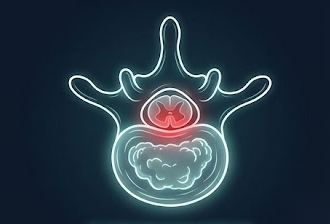
A thoracic disc can press on the cord or a nerve

Wear, bulging, or herniation of the cushioning discs in the mid-back. It is far less common than in the neck or low back, and the pattern of symptoms matters a great deal.
The thoracic spine — the twelve levels of the mid-back, each attached to a rib — is the stiffest and most protected part of the spine, so disc herniations here are uncommon. When they do occur, a herniated or degenerated disc can irritate a nerve root, producing a band-like strip of pain, burning, or numbness that wraps around the chest or abdomen along the path of that nerve (thoracic radiculopathy). Because the pain wraps rather than shooting down a limb, it is often mistaken at first for heart, lung, gallbladder, or abdominal problems.
The more important concern is the spinal cord. The thoracic canal is relatively snug, so a large or calcified central disc can press on the cord itself and cause thoracic myelopathy: leg heaviness or weakness, unsteady walking, and, in severe cases, bladder or bowel changes. This is a different and more serious problem than a pinched nerve, and its warning signs deserve prompt evaluation.
Many thoracic disc bulges are found incidentally on imaging and never cause trouble; these are watched, not operated on. Our approach at Brown is careful selection: confirm that the disc actually explains your symptoms, reserve surgery for cord compression or truly refractory pain, and — because the cord does not tolerate being handled — choose the approach that reaches the disc without retracting it. The reasoning behind each option is explained throughout this page.
The rib-anchored mid-back is stiff and protected, so thoracic disc herniations are far rarer than neck or low-back ones.
A pinched thoracic nerve wraps a strip of pain or numbness around the chest or abdomen, mimicking other conditions.
A large or calcified central disc can press on the spinal cord itself (myelopathy), which is more serious.
Many are incidental. The key is confirming the disc explains the symptoms before considering surgery.
Band-like chest or abdominal pain has many causes and should first be checked for heart, lung, and abdominal problems. From the spine side, seek prompt care for signs of cord involvement: leg heaviness or weakness, unsteady or wide-based walking, a rising level of numbness on the trunk, or any new bladder or bowel changes. These suggest myelopathy and should not wait.
Surgery for a thoracic disc is aimed at relieving pressure on the cord or nerve. Select a symptom to see what to realistically expect, and which findings are more urgent.
Select a symptom to see how treatment typically affects it.
Each thoracic level maps to a band-like strip of the trunk, which is why the pain wraps at a particular height. Pick a level to see the band and findings it most often fits — educational, not a diagnosis, and the thoracic differential is broad.
This interactive tool is provided by the Norman Prince Spine Institute. It is a pattern-recognition aid for education and should be correlated with your exam and imaging by a clinician.
Thoracic disc surgery is reserved for well-selected patients. Choose a category, then select a factor to learn more.
Select a factor to see how it affects candidacy and which operation fits.
Because many thoracic discs are incidental and symptoms often settle, most patients are managed without surgery. Surgery is reserved for cord compression (myelopathy) or disabling pain that has not responded to a fair non-surgical trial.
An incidental or mildly symptomatic thoracic disc is typically watched. Physical therapy, activity changes, anti-inflammatory or nerve-pain medication, and, in selected cases, an image-guided injection can control band-like pain while it settles. Serial exams and imaging make sure the cord is not becoming involved.
When the cord is compressed or pain is truly refractory, surgery removes the offending disc. The guiding principle is that the thoracic cord must not be retracted, so the approach is chosen to reach the disc from the side or front rather than pulling the cord aside. The right corridor depends on where the disc sits and whether it is soft or calcified.
Select an approach to see, in one place, how it works step by step and what to expect. The choice is driven by the position and hardness of the disc and the need to avoid handling the spinal cord.
When a thoracic level is fused, screws and rods hold the segment steady while it heals. See how those screws are placed through small incisions, using robotic navigation.
The three surgical corridors, side by side. For the thoracic spine the first question is often whether to operate at all; once surgery is warranted, the approach is matched to where the disc sits and whether it is soft or calcified — always to reach it without retracting the cord.
| Approach | Corridor | Reaches | Best for | Typical recovery |
|---|---|---|---|---|
| PosterolateralTranspedicular · from behind | From behind and to the side; no chest entry | Soft or lateral discs, behind the cord line | Soft, lateral, or paracentral discs | Quicker; no lung to re-expand, sometimes light hardware |
| TransthoracicLateral · through the chest | From the side, entering the chest cavity | Central or calcified discs, from in front of the cord | Central or calcified discs pressing the cord | Longer; chest drain and lung re-expansion, reconstruction |
| Minimally InvasiveThoracoscopic · small incisions | Small, camera-assisted incisions (mini-open or scope) | Selected favorable discs, with less tissue disruption | Favorably positioned discs in suitable patients | Faster when suitable; candidacy depends on the disc |
All three share one principle: the thoracic cord is never retracted. Which corridor fits depends on where the disc sits and whether it is soft or calcified — and, before any of them, on confirming the disc truly explains the symptoms. Decided together with your surgeon.
This educational resource was developed by the Division of Spine and Spine Tumor Neurosurgery at Brown University Health to help patients and families understand thoracic disc disease and its treatment options. Because thoracic disc problems are uncommon and demanding, our surgeons emphasize careful patient selection and, when surgery is needed, choosing the approach that reaches the disc while protecting the spinal cord.


For full faculty profiles, visit the Brown Neurosurgery Spinal Surgery Division.